Ferguson traces the history of finance from ancient Mesopotamian clay tablets to modern derivatives, making the case that financial innovation has been as important to civilization as any technological breakthrough. Money, credit, banking, insurance, bonds, stocks—each emerged to solve a specific problem and each transformed society in ways its inventors never anticipated.
The best chapters cover the Medici banking dynasty, the invention of the bond market, and the rise of central banking. Ferguson is excellent at showing how financial instruments that seem abstract were actually responses to concrete needs—war financing, trade risk, crop failure. The Rothschild family's use of information networks to front-run markets after Waterloo reads like a thriller.
The narrative loses momentum in the modern era. The chapters on hedge funds, real estate, and the 2008 financial crisis feel rushed compared to the historical sections—partly because the book was published in 2008 and the crisis was still unfolding. Ferguson's analysis of subprime mortgages is competent but lacks the depth of dedicated treatments.
Ferguson's writing style is accessible and engaging, though he occasionally oversimplifies for narrative convenience. His thesis—that financial history is central, not peripheral, to human history—is convincingly argued.
For the hedge fund story told in much greater depth, read Mallaby's *More Money Than God*. For how currencies collapse when financial systems fail, try *When Money Dies*. For the crypto-native chapter of this story, *The Infinite Machine* covers Ethereum's origin. And for the Medici story with more color, Strathern's *The Medici* is the companion read.
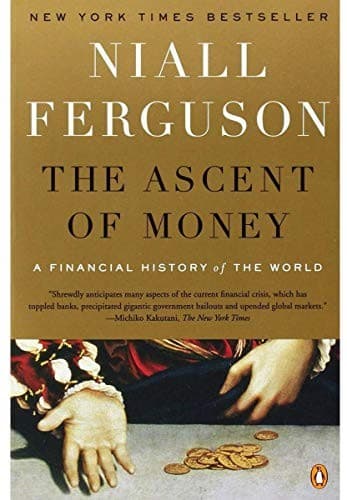
The Ascent of Money
by Niall Ferguson
- Published
- February 20, 2024
- Reading Time
- 1 min