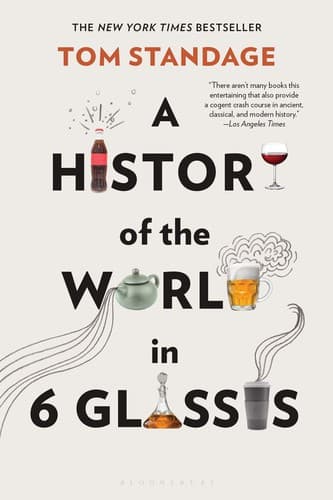
Standage's premise is irresistible: six beverages—beer, wine, spirits, coffee, tea, and Coca-Cola—each defined an era of human civilization. Beer enabled the agricultural revolution and early cities. Wine was the drink of Greek philosophy and Roman empire. Spirits fueled the Age of Exploration and the slave trade. Coffee powered the Enlightenment and the financial revolution. Tea built the British Empire. Coca-Cola became the symbol of American globalization.
It's a gimmick, but a brilliant one. By using drinks as a lens, Standage finds fresh angles on familiar history. The coffee chapter is the standout—coffeehouses in 17th-century London were the original coworking spaces, where merchants, scientists, and writers mixed freely. Lloyd's of London started as a coffeehouse. The Royal Society held early meetings in one. Coffee replaced beer as the daily drink and, Standage argues, the resulting sobriety helped kickstart the scientific revolution.
The book is short (311 pages), moves fast, and never overstays its welcome in any era. Each section is essentially a self-contained essay, which makes it easy to pick up and put down.
The downside is that the connections sometimes feel forced. Not every historical development maps neatly onto a beverage, and Standage occasionally stretches to maintain the conceit. The Coca-Cola chapter is the weakest—more corporate history than civilization-shaping narrative.
For another unconventional lens on history, *Guns, Germs, and Steel* uses geography and biology instead of beverages. For the financial side of how trade goods shaped empires, *The Ascent of Money* covers the economic infrastructure that moved these drinks around the world.
A History of the World in 6 Glasses
by Tom Standage
- Published
- May 1, 2024
- Reading Time
- 1 min