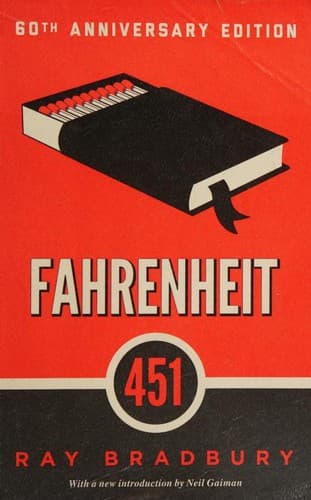
Fahrenheit 451 tries to be Brave New World—and doesn't quite succeed. Reading it shortly after Huxley's novel only made that gap more obvious. The themes are nearly identical, but Bradbury's take feels diluted. Where Brave New World is layered and disturbing, Fahrenheit 451 feels simplistic and overly moralistic.
This book came out 22 years after Huxley's, yet somehow feels less mature. The characters are flat, the story is predictable, and the dystopia feels more like a high school cautionary tale than a fully realized world.
That said, critics aren't wrong to praise the prose. Bradbury writes like a poet:
"The magic is only in what books say, how they stitched the patches of the universe together into one garment for us."
"There must be something in books, something we can't imagine, to make a woman stay in a burning house."
The language is beautiful. The symbolism—fire, the mechanical hound, the phoenix—lands with imagery if not with depth. Goodreads gives it 3.97 stars with nearly 2.8 million ratings. Common praise: poetic language, timeless message about conformity. Common criticism: weak characterization (especially women), confusing prose at times, outdated technological predictions.
Here's the honest assessment: if you're building a dystopia reading list, this belongs on it—alongside Brave New World (control through pleasure), 1984 (control through surveillance), and Animal Farm (control through propaganda). Each offers a different mechanism. Bradbury's contribution is censorship and speed: a world moving too fast to think, where books are burned because they're too slow, too uncomfortable, too real.
But if I'm ranking them? This is fourth of four. The ideas are important; the execution doesn't match Huxley or Orwell. Read it for completeness, read it for the prose—just don't expect the depth of its predecessors.