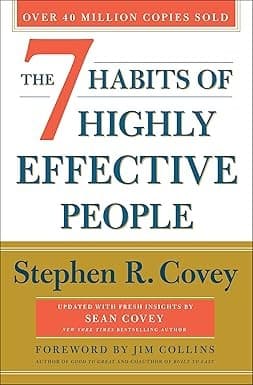
Covey's distinction between the "character ethic" (integrity, courage, patience) and the "personality ethic" (techniques, quick fixes, positive mental attitude) is the book's most valuable idea. He argues that most self-help focuses on personality—surface-level tricks—when real effectiveness comes from character. It's a framework that's aged better than the book itself.
"Begin with the end in mind" is the habit that stuck with me most. Writing a personal mission statement sounds corny until you actually do it and realize you've been operating without one. "Seek first to understand, then to be understood" is another that sounds obvious but almost nobody practices—most people listen just long enough to formulate their response.
The problem is the packaging. Covey writes in corporate seminar prose—lots of quadrants, matrices, and phrases like "synergize" and "paradigm shift" that make you want to close the book. The 7 Habits framework itself (be proactive, begin with the end in mind, put first things first, think win-win, seek to understand, synergize, sharpen the saw) is solid. But it takes 400+ pages to deliver what could be a pamphlet.
The book sold 40 million copies for a reason: the principles work. But reading it feels like sitting through a training seminar when you could be reading the slides.
For a sharper, more philosophical take on personal effectiveness, read Four Thousand Weeks—Burkeman argues that accepting your limits is more powerful than optimizing your habits. For the ancient version of Covey's character ethic, try Meditations by Marcus Aurelius.