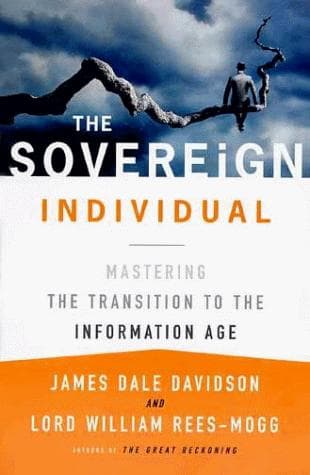
The Sovereign Individual is an important book filled with insights everyone should at least be familiar with. But it's also a long-winded essay by Eurocentric, occasionally paranoid doomsayers. Many of its predictions about technology's relationship with society have aged surprisingly well—or at least landed close enough to reality to explain its lasting relevance.
Written in 1997, the book predicted:
- Cryptocurrency and "cybermoney" — 11 years before Bitcoin's whitepaper
- The gig economy and remote work — decades before COVID accelerated both
- Rise of nationalism and populism — as nation-states lose legitimacy
- Social media filter bubbles — information fragmentation and tribal epistemics
- Income inequality within nations — as borders become less meaningful for the mobile elite
It's hard to say whether that accuracy is due to genuine foresight or simply the result of throwing every idea at the wall and seeing what sticks. The book leans heavily on prediction but often presents claim after claim with little to no evidence. That gets tiring fast. Some of its more speculative conclusions have aged poorly—everything it had to say about Y2K, for example, is now more amusing than alarming.
Having worked full-time in crypto since 2019, I see clearly why this book resonates so deeply within the industry. Its focus on self-sovereignty and individual empowerment aligns closely with the ethos of crypto, particularly around ideas like self-custody. The core thesis—that information technology shifts power from states to individuals—is the philosophical underpinning of Bitcoin maximalism.
But the critics aren't wrong. Goodreads reviewers note the "elitist perspective focusing only on wealthy individuals" and "lack of empathy for those unable to escape systems." The book essentially says: the mobile rich will escape taxation and state control; everyone else will be left behind. It's less prediction than aspiration—and you can almost see the elbow patches on their blazers and the tin foil in their hats.
TL;DR: It's a sharp mental exercise wrapped in some eccentric packaging. Read it for the framework, not for the prophecy.
For the opposing view, pair this with James C. Scott's Seeing Like a State—one book on how states exercise control through legibility, the other on how technology enables escape from that control. And for the crypto-native application of these ideas, read The Infinite Machine (Ethereum's origin story) or Life After Google (Gilder's blockchain thesis).