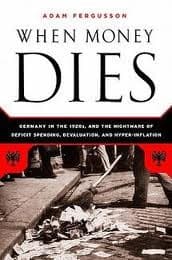
Reading When Money Dies immediately after The Ascent of Money, and seeing both ends of a financial spectrum—progress and collapse—was pretty enlightening.
Money means different things to different people. But when it breaks, it's broken. This book details the hyperinflation crisis in Weimar Germany, showing what happens when a central bank spirals out of control and a currency becomes worthless. By November 1923, a single US dollar equaled 4.2 trillion German marks. Workers were paid twice daily because prices rose between morning and afternoon.
It's chaos, and it's not abstract—Fergusson makes the consequences feel painfully human. Pensioners watched life savings become worthless. Middle-class families who'd saved responsibly found themselves worse off than those who'd borrowed recklessly. The social fabric disintegrated.
The critical reception is polarized—and honestly, both sides are right. The Wall Street Journal called it "one of the most blood-chilling economics books I've ever read." The Guardian praised it as "a brilliant account of how Germany's Weimar Republic was consumed by hyperinflation." But Goodreads reviewers are blunter: "one of the driest, most boring books I've seen," and "rendered sterile and devoid of life."
It is dry. The parade of statistics and dates can numb. But the dryness is almost appropriate—hyperinflation is monotonous horror. Each day is a new disaster, each week worse than the last, until the scale becomes incomprehensible.
If you're in crypto or finance, even just skimming When Money Dies gives you context for why people care so deeply about monetary policy, hard assets, and self-custody. When Bitcoiners talk about "number go up" and sound money, this is the historical shadow they're responding to.
Pair this with The Sovereign Individual for the forward-looking argument about escaping state monetary control, or The Infinite Machine for how Ethereum emerged as an alternative financial layer.