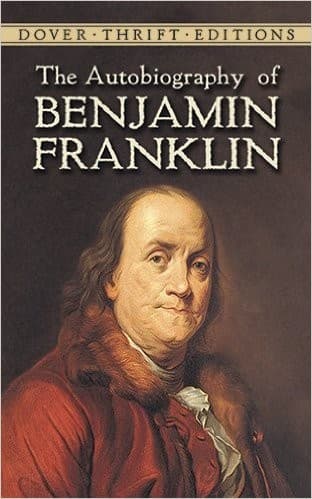
It's refreshing to read the personal account of a level-headed individual during a time when humanity, broadly speaking, was not. Meditations by Marcus Aurelius has a similar vibe—but this one's funnier.
I'm no Franklin scholar, but I know he was a frisky guy and a high-ranking Freemason. None of that makes it into the book. Instead, you get a calm, meticulous, and almost annoyingly rational man reflecting on his youth, his hustle, and his ever-present obsession with self-improvement.
The famous 13 virtues section is essentially the first productivity system. Franklin tracked his adherence to temperance, silence, order, resolution, frugality, industry, sincerity, justice, moderation, cleanliness, tranquility, chastity, and humility—reviewing his performance weekly, focusing on one virtue at a time. As he noted:
"We may give Advice, but we cannot give Conduct."
"There will be sleeping enough in the Grave."
The Seven Habits of Highly Effective People explicitly cites Franklin's influence. The self-improvement industry starts here.
What's strange is how modern it all feels. Franklin talks about productivity, public image, and personal habits like a 1700s life coach. There's no real drama, no hot takes—just a deeply curious man trying to live well and do good. It's kind of dry, kind of brilliant.
Critics note the book is incomplete—it stops at 1757, missing the Revolutionary War, the famous kite experiment, and his diplomatic years in France. The later sections show fatigue. And some find it egotistical. Goodreads (3.85 stars, 91K ratings) reflects the divide.
But the incompleteness is also poignant. Franklin died before finishing. What we have is the man before the legend—hustling in Philadelphia, running a print shop, forming clubs, accumulating influence through quiet industry. The mythic Franklin comes later; this is the man learning the trade of being himself.
For the Stoic parallel, read Meditations. For the modern application of Franklin's ideas to focus and productivity, try Deep Work or Four Thousand Weeks.