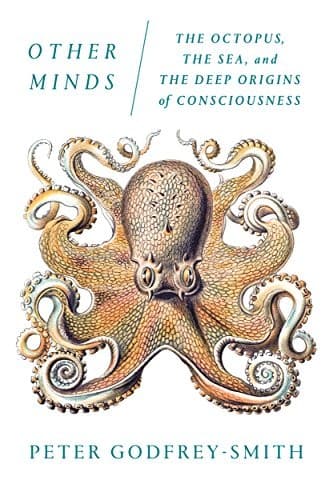
Godfrey-Smith is a philosopher of science who scuba dives with octopuses—and that combination produces something genuinely unique. The book explores how cephalopods evolved complex intelligence on a completely separate branch from vertebrates. Our last common ancestor was a simple wormlike creature 600 million years ago. Octopuses developed their own path to cognition independently.
This makes them the closest thing to meeting an intelligent alien. Their nervous system is radically different—two-thirds of their neurons are in their arms, which can act semi-autonomously. They have no bones, change color and texture in milliseconds, and live only 1-2 years despite their intelligence. Evolution gave them brains but not longevity, which raises uncomfortable questions about what consciousness is for.
Godfrey-Smith is careful not to over-anthropomorphize. He describes octopuses opening jars, recognizing individual humans, and engaging in what looks like play—then honestly acknowledges the difficulty of interpreting these behaviors. Is an octopus "curious" in the way we mean the word? We don't know, and the uncertainty is part of the point.
The weaker sections speculate about the origins of subjective experience in ways that feel inconclusive. But the observational chapters—Godfrey-Smith sitting on the ocean floor watching octopuses interact—are beautiful and strange.
For the evolutionary story of how complex life emerged from simple chemistry, read Life Ascending by Nick Lane. For the philosophical questions about consciousness and self-reference that octopus intelligence raises, try Hofstadter's I Am a Strange Loop.