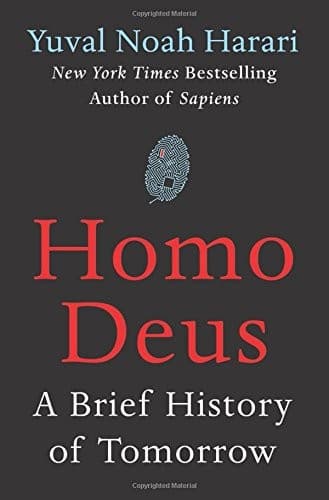
Harari's sequel to Sapiens asks: now that humanity has largely conquered famine, plague, and war, what comes next? His answer: we'll pursue immortality, happiness, and divinity—and in the process, we may render ourselves obsolete. Algorithms that know us better than we know ourselves will make our decisions, and "Dataism"—the belief that data flow is the supreme value—may become the next great religion.
The strongest sections build on Sapiens' framework. Harari's analysis of how humanism replaced theism as the dominant ideology, and how technology may now be replacing humanism, is sharp. The argument that liberal democracy depends on the assumption that humans are the best decision-makers—and that AI threatens that assumption—feels more relevant now than when it was published in 2017.
Where the book struggles is in the gap between diagnosis and prediction. Harari is excellent at identifying trends and asking uncomfortable questions. He's less convincing when he extrapolates those trends into specific futures. The "Dataism" concept, while interesting, is more provocation than analysis. And some predictions—like the idea that algorithms will eliminate free will—conflate technical capability with social adoption.
It's weaker than Sapiens. The first book had the benefit of analyzing things that actually happened; this one is speculating. But the questions Harari raises—What happens when algorithms surpass human decision-making? What is consciousness worth in a world that doesn't need it?—are the right questions to be asking.
For the technology side of this future, Chip War covers the hardware arms race. For the crypto response to centralized data control, try The Sovereign Individual.