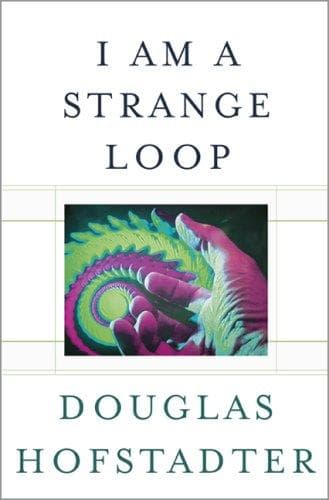
Hofstadter returns to the territory of Gödel, Escher, Bach with a tighter focus: what is the "I"? His answer: consciousness emerges from self-referential loops. Just as Gödel's incompleteness theorem showed that mathematical systems can refer to themselves, our brains create a symbol—a self-model—that refers to itself, and that recursive loop is what we experience as awareness.
The book is more personal and accessible than GEB, partly because Hofstadter grounds the abstract ideas in grief. After his wife's unexpected death, he found himself experiencing her perspective, thinking her thoughts—as if her "pattern" continued to exist inside his brain. It's a moving and philosophically provocative way to approach the question of what survives death.
The core argument—that consciousness is a matter of degree, not kind, and that even simple systems have rudimentary "selves"—is fascinating. Hofstadter assigns a rough "soul size" to different organisms based on their capacity for self-reference. A mosquito has a tiny loop. A dog has a richer one. A human has the most complex. It's speculative but internally consistent.
Where the book falters is in repetition. Hofstadter circles the same ideas from multiple angles, which can feel like being trapped in a loop yourself. The analogies sometimes obscure rather than clarify—by the third extended metaphor involving video feedback, you get the point.
For the octopus version of this question—intelligence that evolved independently from ours—read Other Minds. For the physics of what time and selfhood might actually be, try Rovelli's The Order of Time.