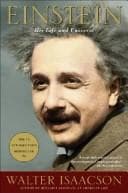
Isaacson's Einstein biography succeeds where most science biographies fail: it makes the physics feel essential to understanding the person. Einstein's breakthroughs didn't come from superior mathematical ability—they came from thought experiments, from his willingness to take simple questions seriously and follow them to radical conclusions. What would it be like to ride a beam of light? That question led to special relativity.
The early chapters are the strongest. Young Einstein—patent clerk, mediocre student by academic standards, outsider to the physics establishment—producing four groundbreaking papers in 1905 (the "miracle year") is one of the great stories in science. Isaacson captures the intellectual audacity required to challenge Newton's framework while working a day job.
The middle sections on general relativity are fascinating if you're willing to engage with the concepts. Isaacson doesn't require math but does require attention. The idea that mass curves spacetime—that gravity isn't a force but a geometry—is explained clearly enough that you feel the paradigm shift.
Where the book drags is in Einstein's personal life. The failed marriages, the absent fathering, the political activism—all important but told at a length that tests patience. At 675 pages, the biography could have been tighter. The post-1925 chapters, covering Einstein's unsuccessful quest for a unified field theory, feel melancholy and repetitive.
For Isaacson's other major biography, Steve Jobs offers a similar treatment of a different kind of genius. For the physics itself explained with more poetic economy, try Rovelli's The Order of Time.