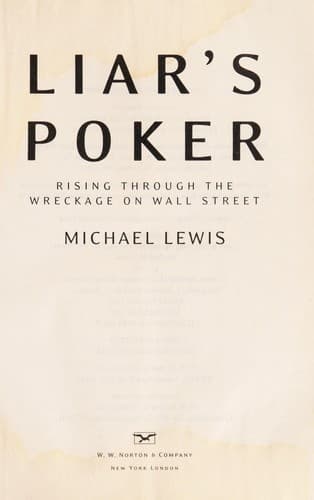
I wouldn't read this again—but it launched Michael Lewis, and the world (and Hollywood) has benefited from that.
Lewis was a young bond salesman at Salomon Brothers when he wrote this exposé of 1980s Wall Street excess. The book captures an era of unrestrained greed, absurd compensation, and practices that would eventually blow up the global economy. As one reviewer noted:
"Never before have so many unskilled twenty-four-year-olds made so much money in so little time."
What makes the book historically significant is how presciently it illustrates the practices—CMOs, junk bonds, the "originate and distribute" model—that presaged the 2008 financial crisis. Lewis didn't predict the crash, but he documented the culture that made it inevitable.
The cruel irony: Lewis intended the book as a cautionary tale. Instead, ambitious young financiers read it as an instruction manual. Applications to finance jobs spiked after publication. The satire became aspiration.
Goodreads (4.15 stars, 111K ratings) remains enthusiastic decades later. Critics praise Lewis's gift for making complex financial systems accessible—the same talent he'd bring to Moneyball, The Big Short, and Flash Boys.
It made me want to write a book. And if you're in finance, this should be required reading. It captures a moment, a mindset, and a madness that still echoes through the industry today.
For Lewis's evolution, read Flash Boys next—same author, same industry, different era. For the mathematical critique of the models Wall Street abused, try Mandelbrot's Misbehavior of Markets.