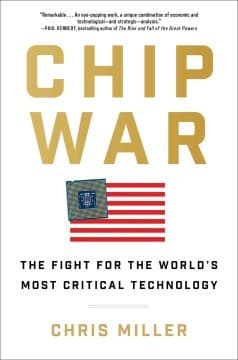
This is the most important technology book of the last five years. Miller traces how semiconductors became the most strategically valuable resource on Earth—more important than oil, more contested than any territory. The supply chain is staggeringly concentrated: TSMC in Taiwan fabricates the majority of the world's advanced chips, ASML in the Netherlands makes the only machines capable of extreme ultraviolet lithography, and a handful of companies control the entire pipeline from design to fabrication.
Miller makes this technical subject genuinely thrilling by framing it as geopolitical thriller. The U.S.-China rivalry over chip supremacy isn't abstract—it determines who controls AI, military systems, and the global economy. China spends billions trying to build domestic chip capacity and keeps failing, because semiconductor manufacturing requires decades of accumulated expertise that can't be bought or stolen.
The historical sections are equally strong. The story of how Silicon Valley got its name—from actual silicon chip fabrication in the 1960s—to how offshoring production to Asia created the current dependencies is told with clarity and momentum.
If there's a weakness, it's that the book occasionally reads like a policy brief. The final chapters on export controls and industrial policy are important but less engaging than the earlier narrative history.
For more on how geography shapes geopolitical power, pair with any of Peter Zeihan's books—Disunited Nations or The Accidental Superpower. For the financial side of technology competition, try Flash Boys on high-frequency trading's hardware arms race.