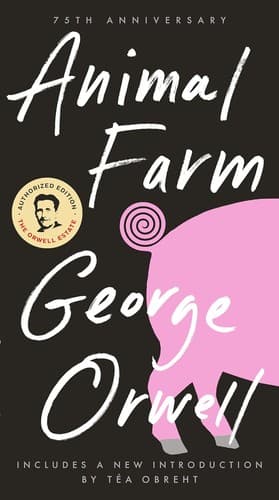
Animal Farm is a must-read for anyone trying to understand how power and propaganda operate. It's never not timely—because what Orwell's satirizing is always happening somewhere in the world.
The allegory is barely disguised: Napoleon is Stalin, Snowball is Trotsky, Old Major is Marx/Lenin, Squealer is the propaganda apparatus. The pigs gradually become indistinguishable from the humans they overthrew. The commandments on the barn wall get quietly edited until only one remains:
"All animals are equal, but some animals are more equal than others."
What makes it devastating is the mechanism. The other animals know something is wrong, but they can't quite articulate it. Their memories are uncertain. The pigs control the narrative, and slowly, the original revolution becomes unrecognizable. By the end, the pigs are walking on two legs and playing cards with humans, and the animals watching through the window can no longer tell which is which.
I won't go too deep here. There are thousands of reviews out there, and let's be honest—most people read this in high school. I listened to it as an audiobook and finished it in one day.
It's fun, funny, and scary. Goodreads gives it 4.02 stars with nearly 4.5 million ratings—one of the most-read books in the English language. Critics sometimes call it heavy-handed, the allegory too explicit, the animals functioning as symbols rather than characters. They're not wrong, but they're missing the point. The explicitness is the point. This is a fable, not a novel.
For the complete Orwell dystopia, follow with 1984—his vision of control through surveillance and fear. Then read Brave New World for Huxley's counterpoint: control through pleasure and distraction. Three mechanisms of tyranny, three warnings that remain relevant.