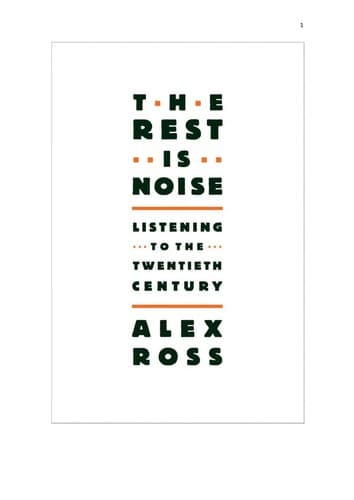
Ross's history of 20th-century classical music is one of those books that makes you realize how little you knew about a subject you thought you understood. The book traces how music evolved from the lush romanticism of Strauss and Mahler through the atonal experiments of Schoenberg, the political weaponization of music under Stalin and Hitler, the American minimalists, and everything in between.
What elevates this above a standard music history is how Ross weaves music into politics. Shostakovich composing under the constant threat of Stalin's disapproval. Britten navigating his pacifism and homosexuality in mid-century Britain. Copland's "Appalachian Spring" becoming the sound of American identity. Music wasn't created in a vacuum—it was shaped by war, ideology, and power.
Ross writes for a general audience without dumbing down the music theory. You don't need to read notation to appreciate his descriptions of how a piece sounds and why it matters. The prose itself has a musical quality—rhythmic, building toward climaxes, knowing when to be quiet.
At 640 pages, it's a commitment. Some chapters on lesser-known composers drag, and the post-1970 sections feel compressed compared to the lavish attention given to the pre-war era. But the best chapters—on Stravinsky's "Rite of Spring" riot, on the Cold War music competition between the U.S. and USSR—are extraordinary.
For another deep dive into a musician's world, try Keith Jarrett by Ian Carr. For the rock counterpart to this classical history, Hammer of the Gods covers Led Zeppelin's era. For the philosophy of sound itself, Cage's Silence is the radical counterpoint.