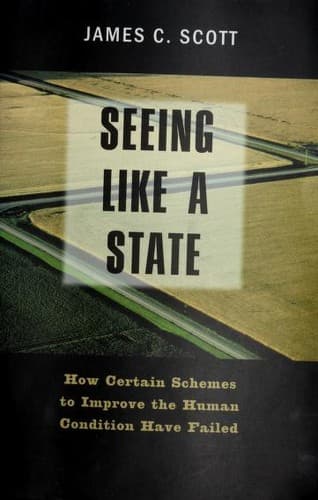
Much like The Sovereign Individual—which I reviewed in my first issue—Seeing Like a State has good ideas buried under an overconfident tone. The content is valuable, but the author's arrogance is hard to ignore. Maybe it was the narrator, but the whole thing gave off strong "elbow patch" energy.
The core concepts are genuinely important. Legibility: states need to simplify complex realities to govern them—standardized names, grid cities, scientific forestry—but that simplification destroys the local knowledge that made systems work. High modernism: the belief that rational, top-down planning can engineer society like a machine. Metis: the practical, place-based wisdom that can't be universalized or written down.
Scott's case studies are devastating. Prussian "scientific forestry" optimized for timber yields, then forests died within a generation because monocultures couldn't sustain themselves. Soviet collectivization tried to rationalize peasant farming, killing millions. Brasília was designed as a modernist utopia and became unlivable—residents built informal settlements to create the street life Le Corbusier had designed out.
"Designed or planned social order is necessarily schematic; it always ignores essential features of any real, functioning social order."
The pattern is consistent: schemes that ignore local knowledge fail. The tragedy is that planners keep making the same mistake because legibility is what makes governing possible.
But the repetition is wild. I'd skip to the middle of a chapter, and Scott would still be unpacking the same example from earlier. The first half had me engaged, but I started skimming later—and honestly, I don't think I missed much. Critics on Goodreads echo this: "unnecessarily long," "academic prose dense," "diagnoses problems better than proposing alternatives."
Save yourself some time: find a high-quality YouTube video that summarizes it, or read chapters 1-4 and skim the rest. The ideas are worth knowing; the full 464 pages may not be.
Pair this with The Sovereign Individual for the opposite lens—technology enabling escape from state legibility—or Guns, Germs, and Steel for another macro-historical framework.