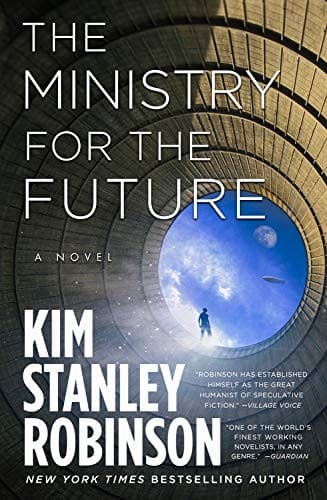
As The Overstory explains the mindset of the environmental movement from the 1960s, Ministry for the Future imagines what the future could look like if those warnings aren't taken seriously.
I won't spoil too much, but the book opens with a brutal depiction of climate change effects on a region with a relatively small carbon footprint—a heat wave in India that kills millions. As many have noted, one of the more tragic realities of climate change is that the countries least responsible will often suffer the most—at least at first.
What follows is a globe-spanning narrative filled with policy ideas, sci-fi tech, and climate interventions: carbon coins as alternative currency, pumping water from beneath glaciers to slow their slide, geoengineering, rewilding, eco-terrorism as political tool. Robinson throws everything at the wall.
Goodreads (3.86 stars, 42K ratings) is divided. Praise: "powerful opening," "one plausible scenario for how we might actually address climate change," "refreshingly grounded." Criticism: "excessive exposition and technical infodumps," "weak character development," "unrealistic political optimism," "underestimates human irrationality."
That last criticism is fair. Robinson imagines a world where, eventually, institutions act rationally. That's optimistic. But the book isn't prediction—it's possibility space.
Around the 17-hour mark of the audiobook, I started to lose the thread a bit—but it's still great. I plan to re-listen someday. There are too many smart, not-too-far-off ideas packed in here to not revisit.
That's the power of speculative fiction: authors float a vision, and decades later, some polymath connects the dots and changes the world.
For the emotional groundwork, read The Overstory first. For Robinson's other work, the Mars Trilogy covers similar themes of planetary transformation.