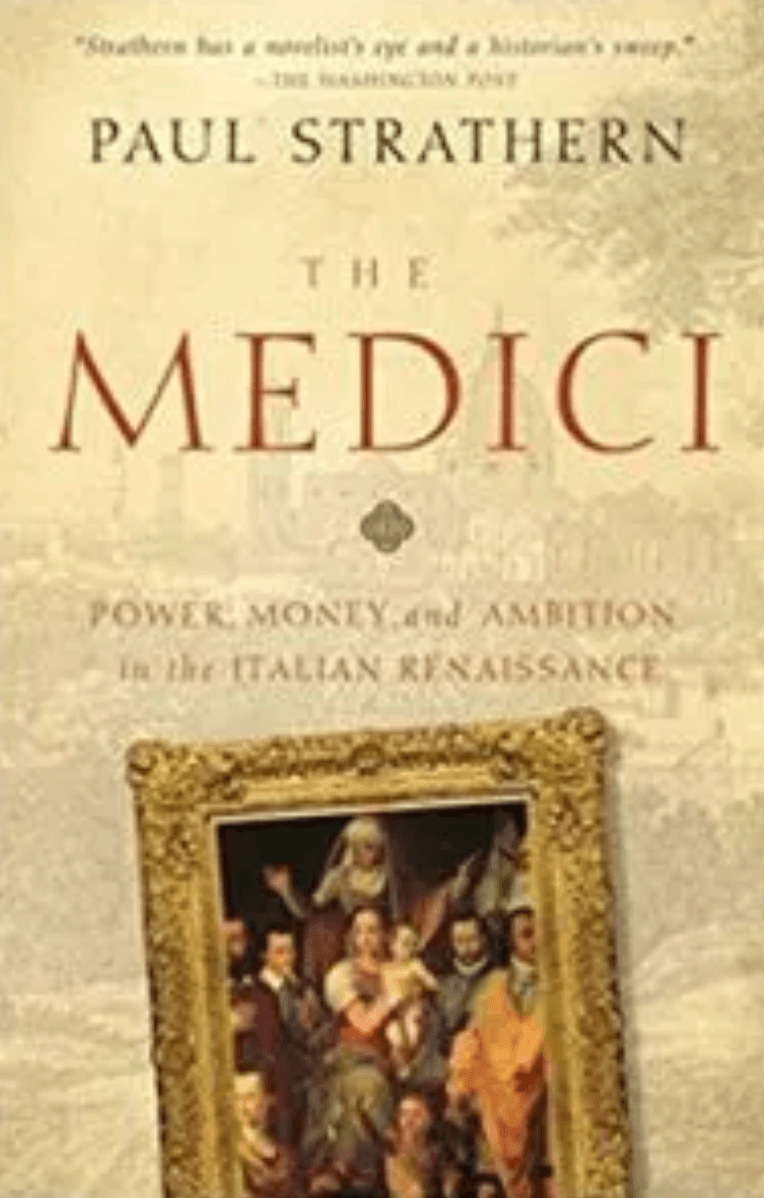
The Medici family bankrolled the Renaissance. Not metaphorically—literally. They funded Brunelleschi's dome, patronized Botticelli and Michelangelo, sheltered Galileo, and produced four popes and two queens of France. Strathern traces the dynasty from its origins as Florentine bankers through three centuries of art, politics, assassination, and decline.
What makes the book compelling is how inseparable money and culture were. The Medici didn't patronize art out of pure generosity—it was a strategy for legitimizing power. Commissioning a cathedral or a painting was a political act. Cosimo de' Medici ruled Florence without ever holding formal office, using wealth and patronage to control the city more effectively than any title could.
Strathern keeps the sprawling family history readable by focusing on the key figures: Cosimo the Elder (the banking genius), Lorenzo the Magnificent (the golden age), and the later decline into papal politics and mediocrity. The pacing is good—each generation gets enough attention without the narrative bogging down in genealogy.
The weakness is that Strathern sometimes oversimplifies the political context. Florence's relationship with the papacy, Milan, Venice, and Naples was complex, and the book occasionally glosses over these dynamics in favor of the family drama. The art historical sections are also relatively thin—if you want deep analysis of the works themselves, this isn't the book.
For the financial system the Medici operated within, read Ferguson's The Ascent of Money. For another story of how power and patronage intertwined in Renaissance Italy, the Havana mob parallel in Havana Nocturne is surprisingly apt—different era, same dynamics of money buying influence.