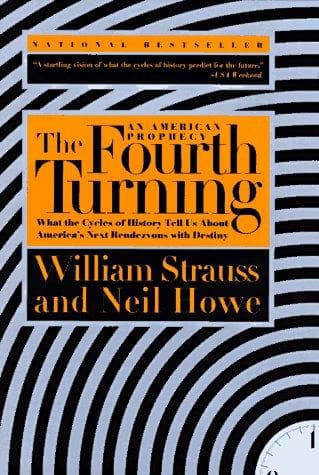
Strauss and Howe's generational theory is one of those frameworks that's more influential than rigorous. The thesis: Anglo-American history moves in roughly 80-year cycles, each containing four "turnings"—a High (post-crisis consensus), an Awakening (cultural upheaval), an Unraveling (institutional decay), and a Crisis (existential threat requiring collective action). Written in 1997, the book predicted a major crisis would hit around 2005-2025. Then 9/11, the 2008 financial crisis, COVID, and ongoing political polarization arrived more or less on schedule.
The pattern-matching is seductive. The American Revolution, Civil War, Great Depression/WWII, and the current era do seem to share structural similarities—each roughly 80 years apart, each involving institutional collapse and reconstruction. The generational archetypes (Prophet, Nomad, Hero, Artist) map onto Boomers, Gen X, Millennials, and Gen Z in ways that feel intuitively right.
But "feels right" is doing a lot of heavy lifting. The theory is unfalsifiable—any major event can be retroactively fitted into the cycle. The generational boundaries are somewhat arbitrary. And the book's tone veers between scholarly analysis and prophecy in ways that undermine its credibility.
Still, as a mental model for thinking about historical patterns, it's useful. Not because the cycles are deterministic, but because they highlight how generational experiences shape collective behavior. People who grew up in crisis eras behave differently than those who grew up in prosperity.
For a more rigorous analysis of how geography and demography shape nations, read any of Zeihan's books. For the opposing lens—how individual randomness trumps structural patterns—try Taleb's Fooled by Randomness.