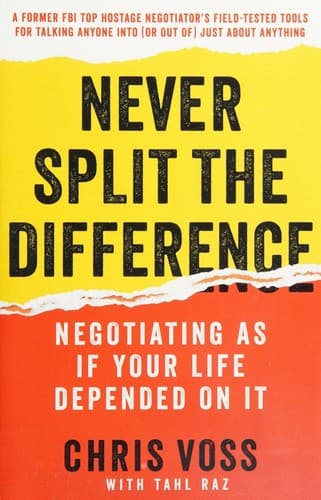
Voss spent decades as an FBI hostage negotiator, and his central insight is counterintuitive: the best negotiators don't argue with logic—they use emotional intelligence. "Tactical empathy," as he calls it, means understanding and acknowledging the other side's feelings without necessarily agreeing with them. It works because people need to feel heard before they'll move.
The techniques are immediately practical. Calibrated questions ("How am I supposed to do that?") shift the burden to the other side without creating confrontation. Mirroring—repeating the last few words someone said—keeps people talking and revealing information. The "accusation audit"—listing every terrible thing the other person might think about you upfront—defuses hostility before it escalates.
What makes this better than most negotiation books is the stakes of Voss's examples. When you've negotiated with bank robbers and kidnappers, salary discussions feel manageable by comparison. The hostage stories are gripping and the principles translate surprisingly well to everyday contexts—buying a car, negotiating a raise, resolving disputes.
The weakness is repetition. Each chapter introduces a technique with a hostage story, then shows it applied in business. By chapter eight, the pattern feels formulaic. Some of the business examples also feel cherry-picked—real negotiations are messier than the clean wins presented here.
Still, this is one of the few business books where you finish with tools you can use the next day. For the philosophical counterpoint on why we're worse at rational decision-making than we think, read Blink. For the deeper psychology of unconscious persuasion, try Subliminal.